Dry, Frizzy, or Both? What Fall Air Is Actually Doing to Your Hair

You can feel the moment it turns. One week your hair’s behaving, and the next the furnace kicks on, the air goes bone dry, and suddenly you’ve got static flyaways, a tight scalp, and ends that feel like straw. Happens every fall like clockwork, and every year a wave of folks land in my chair a little frazzled, wondering what went wrong overnight.
Nothing went wrong. The air just changed on you. But before I hand you the survival kit, I want to separate two problems that almost everybody rolls into one — because they’re different, and the fix for one does nothing for the other.
Dry and frizzy are not the same thing
Dry is a moisture problem. Summer is humid, there’s moisture everywhere, and your hair drinks it in. Then fall hits, the humidity drops off a cliff, the furnace dries the indoor air even further, and your hair gives its moisture up to that thirsty air. That’s the straw feeling, the static, the tight scalp. Moisture fixes it.
Frizz is a texture problem. Frizz is what happens when the cuticle — the outer layer of your hair, which lies down like shingles on a roof — doesn’t lie flat. Rough cuticle means every strand is sticking out slightly instead of lying against its neighbors, and that’s what puffs. You can pour conditioner on frizz all season and it will still frizz, because you’re treating the wrong thing.
Most people have some of both, which is exactly why it gets confusing. So let’s take them in order.

The moisture half: stop washing it away
The first thing I tell people costs nothing. Wash less, and wash cooler. Daily hot-water shampooing in dry season strips the natural oils your hair desperately needs right now. Stretch your washes — every other day, every third if you can — and turn the water temperature down. Hot water feels good on a cold morning, but it’s rough on dry hair and faded color both.
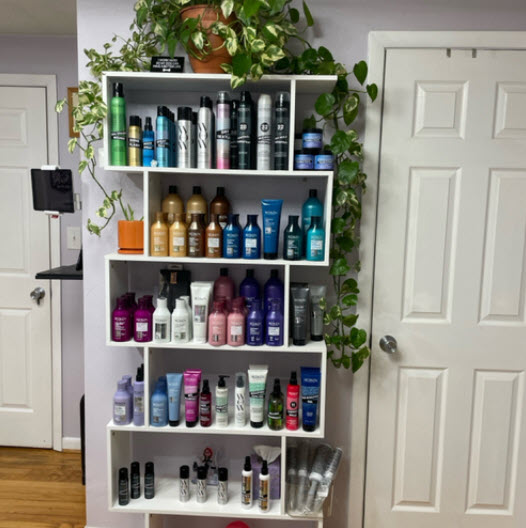
Switch to a moisturizing shampoo for the season, too. Whatever clarifying or volumizing one got you through humid summer is working against you now. This is where I lean on Redken — their moisture-focused line is built for exactly this, gentle cleansing that doesn’t strip, and a conditioner that actually coats the hair instead of rinsing off doing nothing.
And the one most people skip: a deep conditioning treatment. Your everyday conditioner is a quick surface coat. A real treatment soaks in and rebuilds moisture from the inside, and the difference on dry fall hair is night and day. Twenty minutes, twenty-five dollars, right in the studio, and a lot of my clients just add one onto their cut or color through the dry months. Think of it like lotion for your hands in winter — you wouldn’t skip that.
The texture half: what I just added to my menu
Here’s the new thing, and I’m genuinely glad to have it. I’ve brought in a professional Smoothing System.
It works on the texture side — it settles the cuticle down so it lies flat instead of standing up. Flat cuticle means the frizz calms, the puff goes out of it, and your hair stops fighting you every morning. What it isn’t is a relaxer. It doesn’t make you stick-straight and it doesn’t take your body out. If you’ve got a wave you like, you keep it. You just get the version of it that behaves.
The change my clients notice first isn’t in the mirror, it’s in the clock. Getting ready stops being a project. Wash, rough dry, out the door — and it holds when it’s damp out, which around here is most of the spring.
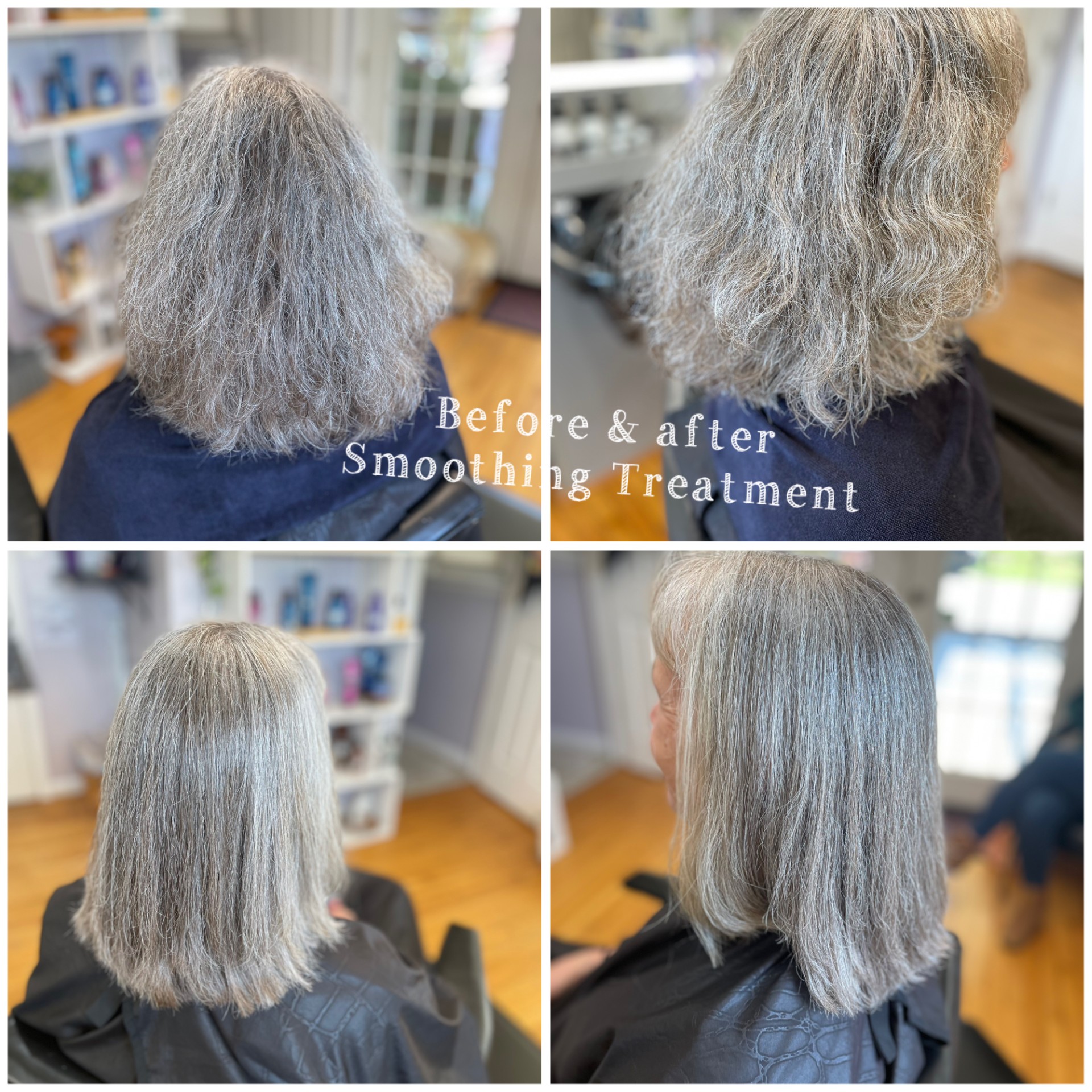
The particulars, because people ask before they book: about two hours, $150 and up and that includes your cut and style, and it lasts up to three months. It’s demi-permanent, not a relaxer — it doesn’t permanently alter your natural texture. The formula is vegan and completely free of formaldehyde, silicones, mineral oils and artificial fragrance. And unlike the older smoothing treatments, you can wash your hair the same day — no 72-hour wait.
Why I think about this most with grey
Grey gets talked about as a color change, and that’s only half of it. When the pigment goes, the texture goes with it — grey hair grows in coarser and more wiry than the hair it replaced. On top of that, your oil glands slow down as you get older, so the scalp produces less of the sebum that used to travel down the strand and keep it soft. Coarser hair, less natural oil, drier air. All three at once, every October.
That combination is why so many women tell me their hair “changed” in their fifties and they can’t figure out what to do about it. Nothing’s wrong. It genuinely did change. And it’s why smoothing and grey blending work so well together — blending handles how the grey looks, smoothing handles how it behaves. Do both and people stop being able to tell you did anything at all.
Which one do you actually need?
Rough guide, and then come let me look at it. If your hair feels brittle and snappy and full of static, that’s moisture — start with the conditioning treatment and the routine changes above. If your hair puffs and frizzes and takes forever to dry no matter what you put on it, that’s texture — let’s talk about smoothing. If you’re nodding at both, we start with moisture and go from there, because smoothing sits better on hair that isn’t parched underneath.
The honest answer is that I can tell in about thirty seconds with your hair in my hands, and the consultation’s free. That’s what it’s for.

Get ahead of it
The folks who sail through the dry season with soft, shiny hair are the ones who set their routine up in October instead of waiting until their ends are crispy in December. It’s a lot easier to keep moisture in than to rescue hair that’s already parched — same as it’s easier to stay warm than to thaw out. And it’s good timing anyway, with the holidays coming and photos and gatherings right behind them.
I’m off Stony Hill Road in Gainesboro, an easy drive from Winchester, Gore, or Stephens City. Book online at stonyhillstudio.glossgenius.com or text me at (540) 877-4057. Tell me what your hair’s doing and we’ll figure out which half of this it is.