Grey Isn’t Just a Color Change. It’s a Texture Change.
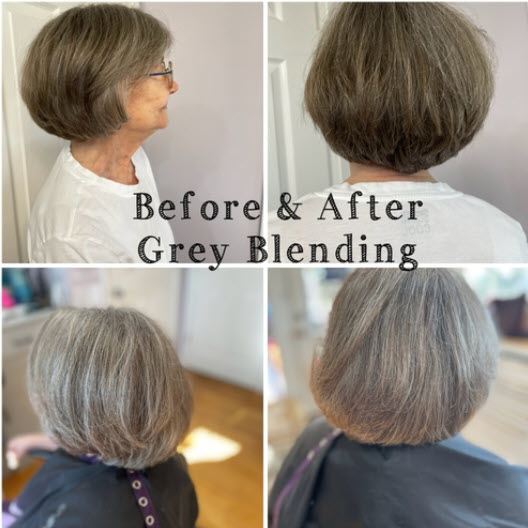
When a client’s first greys come in, they come to me about the color. Almost nobody comes to me about the texture — and the texture is usually what’s actually bothering them.
“It’s wiry.” “It sticks straight up.” “It won’t lie down with the rest of my hair.” “It’s coarse.” I hear those words far more than I hear anything about the shade.
What’s actually happening
Pigment in hair comes from melanocytes — cells sitting in the follicle that deposit color into the strand as it grows. Grey happens when those cells slow down and stop. The hair keeps growing; it just grows without the pigment.
But melanin isn’t only color. It occupies physical space inside the hair. Take it out and you’ve changed the internal structure of the strand, not just its appearance. That’s why grey hair genuinely behaves differently — it isn’t your imagination and it isn’t you being fussy.
At the same time, the follicles producing grey often change their oil output and the shape of the strand they push out. So grey hair frequently arrives coarser, drier, and with more of a will of its own. Three changes at once, and only one of them is the color.
Why grey resists color
This is the part that frustrates people, and it’s worth understanding before you sit in anyone’s chair.
Grey hair often has a tighter, more resistant cuticle. Color has to get through the cuticle to do anything. So the same formula that takes beautifully on pigmented hair can slide right off grey, or grab unevenly, or fade out weeks early.
That’s not a bad colorist. That’s chemistry — and it’s why grey coverage is formulated differently, processed differently, and sometimes pre-treated before the color ever goes on. When someone tells you their grey “won’t hold color,” what’s usually true is that it was treated like non-grey hair.
Blending versus covering
These are two different goals and it’s worth knowing which one you want.
Covering means opaque, uniform, no grey visible. It looks great on day one and it gives you a hard line at the root in three to four weeks. If you like a solid, finished look and you’re happy coming in on a schedule, this is a completely valid choice.
Blending means weaving light and dark through so the grey reads as dimension instead of as grey. It doesn’t erase — it softens. And critically, it grows out without a line, so you’re not on a four-week clock.
I do more blending than covering these days, and it’s usually because of that second point. People don’t dislike their grey nearly as much as they dislike the maintenance of hiding it.
Caring for grey once it’s here
Moisture, consistently. Grey is drier at the source. It needs more than the rest of your head does.
Watch the yellowing. Grey and white hair pick up tone from everything — hard water, sun, product, even the air. A purple shampoo helps, but once a week is plenty. Used daily it goes dull and slightly violet, which is its own problem.
Ease off the heat. Without melanin the strand has less built-in protection, so heat damage shows up faster and reads worse.
If your grey is coming in and you’re not sure what you want to do about it — that’s a good conversation to have before you decide anything. Come sit down. stonyhillstudio.glossgenius.com.